How I Won a $100k Scholarship… Twice — a Complete Guide to Canadian and American Admissions
A complete guide to Canadian and American admissions for STEM students.
Admissions are confusing. From creating an OUAC account to figuring out exactly which extracurriculars to write about on your supplementary applications, the entire process isn't the clearest, especially when applying internationally. I learned a lot about admissions during the 2025 university admissions cycle, and I decided it was too much to just forget and let it go to waste. So, I decided to write this guide and hopefully help someone else!
This guide is mainly for Ontario high school students, but the writing tips apply to any high school student.

Why Listen to Me?
Although only a first year in university as of writing this (and not an admissions officer, professional college counsellor or university official), I've undergone the admissions process for top Canadian and American universities and I have decent results to show for it. In Canada, I won the $100k Schulich Leader Scholarship twice at the (debatably) top 2 universities in Canada. I won ⅕ science scholarships to study CS at the UofT, and ⅓ science scholarships to study CS at the UBC. Schulich leader scholarships are Canada's most coveted undergraduate scholarship, only awarded to Canada's top 100 highest potential STEM students every year. As well, I got into the University of Waterloo for Software Engineering with the Software Engineering scholarship, UofT EngSci, McMaster CS, and Carleton CS.
For U.S. university admissions however, I did not perform well at all :(. I believe this was almost entirely because I did not take any IB courses or AP credits, which makes it nearly impossible to get accepted into any top U.S university as a Canadian (I'll expand more on why later)1.
In the end, the best I can say was that I was waitlisted from UCLA for CS without taking any IB or APs. However, the skills I learned from writing all these American applications are the skills I used to write my Schulich Leader application. I believe the knowledge I have to share is still correct and extremely valuable, even if it didn't net me many great results.
How do I apply to university?
Canadian Admissions (Ontario and BC)
To apply for universities in Ontario, start by creating an account on OUAC (Ontario University Application Center). After you have an OUAC account, you apply to university in two different steps.
First, you apply to universities on OUAC. For some universities (e.g. Carleton, TMU, etc.) this is the entire process. These universities will look at your grades and decide whether or not to admit you, usually starting from December. For universities like Carleton or TMU a 90+ average will get you admitted almost certainly. The deadline for this step is sometime around November, so just get this done ASAP.
Canadian universities will calculate your average using your top 6 (top 5 for UofT EngSci) highest grades in any grade 12 university level course (course code ending with a U for YRDSB students, e.g. ENG4U vs. DCO3O), with all program prerequisites included. This means that if a computer science program requires you to have taken Calculus and Vectors, Advanced Functions and English, these subjects are in your average calculation no matter what. The other 3 courses can be literally any other university level course, from music to history class. As an example, if you are applying to a CS program with the pre-requisites mentioned above, and you achieve a 98 in music, a 95 in French, a 99 in Chemistry, a 93 in Advanced Functions, a 96 in Calculus and Vectors, a 85 in English and a 90 in Physics, your top 6 will not be calculated with music, French, Chemistry, Advanced Functions, Calculus and Physics, but will be calculated with English instead of Physics.
Second, for more competitive university programs, you may need to write a supplementary application. Most of these are pretty quick. For my year, McMaster CS had a 20 minute video interview as the entire supplementary application and Waterloo Software Engineering had four 150-word written questions and a 20 minute video interview. However, just because these responses are short does NOT mean you should treat them without importance. These short response questions are the most important factor behind your admission decision, right behind your grades. Do not treat them like your English homework and leave them to the last day or even the last week or you will get rejected2. Start these as early as possible. As soon as the questions come out you should start drafting responses and editing them every week, while asking upper year friends for feedback. Some programs like Waterloo CS and SE have their admissions form publically available all year round, so you can even get started before you apply on OUAC.
Each university typically has its own portal to write applications. They will email you links to their portals after they confirm your application on OUAC and process it. This process usually takes a week or so, so apply on OUAC early! Applications are typically due near the end of January.
For BC, you have to make an account on EducationPlannerBC and apply through their website. The process is very similar to OUAC just under a different website.
To apply to universities in America, you need to make an account on the Common App website (or other ones like QuestBridge, but Common App is by far the most standard). This process is far more tedious than the OUAC or EducationPlannerBC one. You have to fill out extracurriculars, essays, a 600-word common app essay, self-report grades/get a guidance counselor to upload your transcript, find adults to write you recommendation letters and a lot more.
After creating a Common App account, you simply select the colleges you want to apply for, and all their information and supplementary requirements are right there on the website. Universities like Harvard and Stanford allow you to submit applications directly through the Common App website, whereas MIT makes you submit it through their portal. Research the universities you want to apply for to see if you can do it through the common app or you need to do it on their website.
American admissions start significantly earlier than Canadian admissions. Most applications will be due by the very beginning of January, with some, like the University of Texas, being due in October or November (I missed this one by accident lol). So, you need to start these applications early! Most Americans applying to top schools start writing their college apps in the summer before Grade 12 or even in Grade 11.
American admissions also requires a few things. Some schools require the SAT or ACT (and even if the school doesn't require it, you should get a good score and submit it anyways), and all schools require English proficiency tests for international students under certain circumstances (if you were born and raised in Canada you're good). If you're applying to a STEM major, just make sure to ace the math section of the SAT.
Each program has a grade target that you should aim for to be competitive for admissions. From my experience, as well as looking at past admissions, I would say these are competitive grades for the schools I applied for. I define "competitive" as having a real good shot depending on the rest of your application, and "considered" as needing very strong ECs.
- Waterloo CS & CS/BBA: 97+ to be competitive, 94+ to be considered.
- Waterloo SE: 97+ to be competitive, 94+ to be considered
- Waterloo Tron, CE & SYDE: 98+ to be very likely, 96+ to be competitive, 93+ to be considered
- Tier 3 Waterloo Eng: 90+ to be competitive
- Waterloo Math: 95+ to be competitive, 90+ to be considered
- UofT CS: 98+ to be very likely, 96+ to be competitive, 93+ to be considered
- UofT EngSci: 98+ to be very likely, 96+ to be competitive, 93+ to be considered
- McMaster CS & Eng: 97+ to be almost guaranteed, 95+ to be competitive
- UBC CS: 98+ to be almost guaranteed, 95+ to be competitive, 90+ to be considered
This is by no means definite. I've seen people with 95s get into EngSci and 99s get rejected from UofT CS, Waterloo CS, etc.
American schools aren't included because they care way less about grades. If you've taken the IB or APs, as long as you have a 4.0 GPA you're good for every school ever. However, American schools care about grades for all four years of high school rather than just your grade 12 year, so the GPA calculation counts every academic course you've taken in high school.
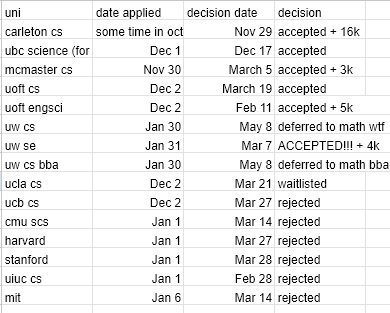
To give you a good idea about timelines for university, this is a spreadsheet I made during the admissions process to track when everything happened3:
How many universities should I apply to?
Generally, it's a good idea to categorize each university that you apply to in one of three categories: safety schools, target schools, and reach schools. Safety schools are schools you think you are almost guaranteed to get into, target schools are schools that usually accept students right around your level, and reach schools are your dream schools that are much more difficult for you to get admitted to.
I recommend applying to 1-2 safety schools, 1-5 target schools, and 1-10 reach schools, depending on how many schools you're willing to apply to. Here's my justification for each number:
1-2 safety schools: By definition, these schools should be nearly guaranteed admission. There's no point in applying to more than 2 safety schools because you should be guaranteed to get into at least one, so every safety school you apply to after 2 is just wasted money and time (each school costs 100+ dollars to apply to btw!). Just pick your favourite safety school and apply.
1-5 target schools: This has a larger range than safety schools because there may be a lot of target schools you're eyeing. It's fine to apply to a large number of target schools because university admissions have a lot of variance and you may not get into your number 1 target school4. I just wouldn't go overboard because you end up wasting time and money when you'll probably get into at least 1 target school out of your top 5.
1-10 reach schools: Honestly, it's definitely not out of the ordinary to apply to even 20+ reach schools. I just wouldn't recommend it because it takes a toll on you. Apply to as many reach schools as you want though, just remember that each application costs lots of time and money. Also keep in mind that by definition, you're unlikely to get into any of these reach schools. So, keep your expectations low and apply to as many as you want to increase your chances.
Which universities should I apply to?
This is probably the most opinionated section of this document, so you can take my advice with a grain of salt.
In my opinion, there are a lot of factors when deciding which schools to apply to, but above all I would consider your personal fit with the university. You'll be able to find a group of people you mesh with at any university, but being at a university with an overall environment that you love is completely different. Different universities have different environments. For example, Waterloo is known to be full of nerds talking about co-op jobs and their studies, whereas Western and Queens are known to be full of parties that last all night! I saw a guy on youtube saying "I have friends at Western that can't remember the number of parties they've gone to, while I can't remember the number of times I've cried in the Waterloo engineering building". You're spending the next 4-5 years of your life studying at university, so it's best to be in an environment that makes you happy and productive.
The best (and pretty much only) way you can feel these environments is by visiting these universities in person on campus tours. You'll quickly see which universities you like and which universities you 100% couldn't spend the next 4-5 years studying at. You should also research school culture online.
Another important factor is the strength of the faculty you'll study at. Waterloo is amazing for tech but its business programs aren't so strong, whereas Western's CS program is decent but its business program is world class. Don't just pick a university because of its name, research the opportunities (clubs, research, professors, etc.) you'll find at the university for your specific discipline of study.
Faculty strength and university environment are two very important things to consider, but I've seen people consider other factors that (IMO) aren't so important. For example, please don't pick your university solely based on where your friends are going. The university you choose to attend will likely be one of the most impactful choices of your life, while it's unlikely that your high school friends are going to be your main group of friends for the rest of your life, let alone the main focus of the rest of your life.
Finally, you should also consider your own personal circumstances. For example, how far away the university is, or how much tuition will cost at that university. A great example of considering personal circumstances would be that if you know you'll apply to the Schulich Leader Scholarship, which is only awarded for students at certain universities, then you can decide between applying to schools by looking at schools that offer the Schulich Leader Scholarship. I lowkey messed up and didn't do this, so I'll use myself as an example. My one safety school was Carleton because it also offered the Dev Degree program. If I were to go back in time, I would apply to York instead because it offers the Dev Degree program as well while also offering the Schulich Leader Scholarship and still being a safety pick.
How should I write a good application?
Now let's finally get into the exciting part! Or, not so exciting if you're actually writing these apps. Let's start with the basics: how should you answer admissions questions?
First of all, it doesn't matter if you're applying to Canadian schools, American schools, or even scholarships. The way you answer these essay prompts should be the exact same, which is in the form of a story. Again, university applications are not like your homework. When they ask you "What are your goals for attending this university", you should NOT directly list every reason why. Instead tell a story about an adjacent experience that led you to your current beliefs or goals, and explain why that aligns with the university's principles.
What to do:
Competing in Hack the North showed me the culture of innovation at Waterloo. I remember the long nights spent designing the date-finding algorithm for my startup CalenDR, and at Hack the North, I saw Waterloo's alignment with my goal to innovate software solutions to solve real-world problems. Having explored software development through projects like CalenDR, I'm eager to leverage resources at Waterloo, like the Velocity incubator and the own-what-you-invent policy, to apply software and make the world a better place.
What NOT to do:
I want to attend the University of Waterloo because I like innovation. I have spent most of my time in high school joining hackathons and building projects with teams, and I believe Waterloo's entrepreneurial spirit and co-op opportunities will help me pursue my goals of creating new technology.
Evidently, there are a few more things than just the story holding the second example back (wording, flow, etc.), but this should give you a good idea of why telling a story is better than just explaining. The main reason is that stories help inject more YOU into the answer. Admissions officers want to know why you are the right candidate, and how your experiences have shaped you as a person. Also, notice how the first one sounds way more authentic and passionate? This is another nice benefit of stories; they are unique to you, allowing you to show your abilities rather than tell them, while allowing the reader to genuinely connect and empathize with your message.
Now you may be thinking, "OK, great. I should write my responses by telling stories… Now how do I make those stories good?". There are a few guidelines I like to follow and a few techniques I like to employ.
Guidelines
- Specificity = authenticity. Arguably the most important guideline to follow when telling stories with the goal of convincing. Think about it, which sounds more authentic to you? "I built a mobile app project using my leadership and coding skills" vs. "By listening to my team's frontend and design ideas during a hackathon, I built an EEG-based mobile app using ReactNative and Python". Obviously example 2, right? Example 2 is convincingly authentic because it uses specific examples, which are difficult to fake. Example 1 comes off as less authentic (even though both statements are equally likely to be untrue) because the vagueness implies that the author either isn't knowledgeable enough, isn't passionate enough about what they're talking about, isn't confident in their skills, or doesn't want to share. It's also just generic. Example number 2 is more interesting and engaging. That's why, in my opinion, it is always better to be too specific vs. not specific enough. You're almost never being specific enough. So be more specific.
- Have a good hook. This also might be the most important guideline to follow. Admission officers read through hundreds of applications a day, and the only ones they admit are the ones they remember. The most effective way to get AOs (admission officers) to remember your application is by hooking them to your story. The start of a story should be an interesting scenario or a unique idea that the AO hasn't seen before. Moreover, if the AO is engaged in your application from the start, they're far more likely to actually pay attention to what you have to say, and are more open to being convinced by you. Imagine these two sentences at the start of a story "I want to study computer science at UofT because coding bridges logic and creativity for me" vs. "When I began editing short videos of my favourite video games in grade 8, I never expected it to intertwine with the logic-filled coding I'd always loved". Which story would you rather read?
- Be unique. While this may sound vague and confusing, it is actually quite simple. By following adjacent principles, such as specificity and having a good hook, you can make any story more unique. However, the most important part to being unique is to pick a story that AOs most likely haven't heard a variation of before. Everyone has joined a couple of clubs, worked a part-time job, or played a sport. Of course, none of these are inherently bad to write about, but it will be way tougher, without some fabulous twist, to be unique. A great way to measure uniqueness is to imagine if your essay was in a random pile of 100+ essays. If your friends picked out your essay at random, could they tell it was written by you? They should be able to know almost instantly. Your essay should only be able to be written by you, and it should only apply to you. Many make the mistake of writing essays that could've been written by anyone. Uniqueness helps you stand out in a sea of applicants. Being unique is being memorable.
- Talk about different things for different prompts. This extends to almost everything. Different answers to different questions should discuss different experiences, different personality traits, different skills and different characteristics of yourself. There's no point in repeatedly advertising the same skill because AOs read applications as a whole, not each essay individually. Furthermore, your application should be a well-rounded picture of you as a whole, detailing your experiences and skills in a way that the AO knows who YOU are.
- Experiences don't have to be directly relevant, as long as you can connect them to the question. Not much to say about this, but it sort of adds on to guideline 4. Talk about the time you lost 30 lbs by playing badminton or the time you got lost in the forest while camping with your parents rather than repeating a story you've already used before in the application. These experiences can easily be connected to certain prompts and they'll work better than using the same story twice.
- Think about why the AOs are asking you this question. Usually this gives some insight into how you should answer a question. E.g. A question asking you what your future goals are is probably trying to understand what drives you and what excites you, while also gauging how ambitious and intellectually curious you are. It might also be trying to decipher how you set and achieve your goals, and how you accomplished your goals in the past.
- Incorporate the university's values into your responses. Different schools value different things. Waterloo wants problem-solvers and entrepreneurs who innovate, lead, and build, while UofT values intellectually curious collaborators who continuously learn and persevere to achieve their goals. Find these values on their websites, at their open houses, etc. and incorporate them into your response to show that you'll fit into the school culture and that you'll benefit them as much as they'll benefit you. This is also just a useful thing to know for picking which school to attend.
- Be yourself!! Don't be afraid to be a little weird or informal, colleges actually love this. Of course, don't talk about your gooning habits in your college essay, but small things like using contractions (e.g. "I've" instead of "I have") actually just sounds more personal while also saving word count. You can also tell stories about how you always tie the right shoe before the left or how you shoot a basketball with your right hand despite being left-handed. These are great examples of being weird enough. Humour is also great in essays, but this can be difficult to execute.
- Don't be flawless. No human is perfect, especially not a 17-year old. Especially for U.S. apps, if you don't mention a single time you struggled or failed, that's a big red flag. Universities don't just want to see how great you are, they want to see how you overcome challenges and how you got to be who you are today. Your character is just as important as your skills, and being humble enough to mention your flaws plays a big role in demonstrating your character. At the same time though, don't overplay your struggles. You need to find a good balance between showing your struggles but not focusing on them. A good guideline for this is to have a small, but significant percentage of your story have some struggle, with the majority of the story being about how you overcame that struggle or what actions you took to succeed.
- Show some personality. Universities don't just want robots who study all day and get good grades. They want to see that you have passion and ambition outside of the classroom, and that you are genuinely a good person.
- Show, don't tell. In your essays, you shouldn't need to tell the admissions officer that you are innovative, creative, or kind. They should be able to infer it themselves from the story you've written. While it's fine to state that you are innovative or creative or kind or any other personality trait, the main way AOs should be getting that impression is from the actions you've done. Who are you more likely to believe is the best, the guy who always claims he's the best on the team at a shooter video game or the guy who always gets the most kills?
- DO NOT get overly philosophical or use too much flowery language. Communication is not about seeming smart, it's about being clear and concise with your ideas. Flowery language especially makes your essay unengaging and unclear. Being overly philosophical or using flowery language is a big red flag to AOs.
- DO NOT focus on background info or other characters over yourself in your story.
- DO NOT give obvious insights, e.g. "I wanted to do well in school so I started working harder."
Techniques
- STAR method for question responses. This is useful even for job interviews, but when asked a question in any interview an easy way to answer it with structure is to use the STAR method. STAR stands for Situation, Task, Action, Result. When asked a question in an interview, tell a related story. Start by describing the situation (S), which should be around 10% of your full response. Then, describe the task (T) you needed to accomplish to resolve that situation, which should also be around 10% of your response. Then, use 50% of your response to talk about the action (A) you took, and the remaining 30% to talk about the results (R) and impacts of your actions. Of course, these are not exact percentages but it should be something similar. This is also a nice guideline for your written responses. Start with a hook and a situation, talk about the action you took to solve that situation and discuss your results. If you have space at the end, you can add a few sentences on how this situation has changed you today and how that is relevant to the university, e.g. "Today, I can't wait to bring this energy to UBC, doing X with Y through Z…".
- Use strong verbs. Which sentence sounds better, "Used PineconeDB and TwitchAPI in Python to look at livestreams and find streamer metadata, creating architectures to improve outreach efficiency" or "Leveraged PineconeDB and TwitchAPI in Python to crawl livestreams and extract personalized streamer metadata, engineering scalable NLP and RAG architectures to optimize outreach efficiency"? Strong verbs make your story more impactful, while also making you look better at whatever you're trying to show AOs you're good at. This is very useful for the Common App extracurricular section and the UofT Engineering extracurricular section.
- Use numbers. This is also another easy trick for bolstering your impact. Which sounds better, "Raised money and hosted workshops for hackathon events by coordinating with executives and partners" or "Cumulatively raised $6000+ and hosted 14 workshops for 2 events by coordinating with executives and partners"? This is also very useful for the Common App extracurricular section and the UofT Engineering extracurricular section.
- Use sensory words. By calling on all 5 of the readers' senses when telling a story, you are better able to immerse them. Example: "Then, I begin assembling my ideas. I precisely record dozens of takes before gathering them all in my editing software, keeping in mind the techniques I've discovered. At the start I make mistakes; I accidentally record a scene too far away or I set my bezier curve too sharp. However, as I push through the long nights of my hand cramped around my mouse, the project I'd envisioned finally starts to materialize, and I understand my initial mistakes were simply the foundation for my later success." This incorporates both sight and touch.
- Circle technique. This is a classic writing technique where your story comes full circle in the end. The idea is that, by referencing the beginning of your story in the conclusion or near the ending, you provide satisfaction to the reader. This is especially helpful for college essays, because by referencing your story in your conclusion (ideally where you're talking about where you are now and how this story relates to the university you're applying for), you're able to highlight how your story is relevant and how you have grown as a person.
- Subversion. Subversion is a great way to hook the reader or to make a sentence stick. A good example is "My dad is the richest person I know—not in capital, but in character."
There are tons more tips I could go through, but these are most of the important ones and more than enough to get you into any school in Canada. If you want to learn more, check out https://www.youtube.com/@elevatedschool, they are awesome.
Now that we've learned all these principles, let's examine our first example again and dissect why one essay response is great and one is just alright.
Example 1:
Competing in Hack the North showed me the culture of innovation at Waterloo. I remember the long nights spent designing the date-finding algorithm for my startup CalenDR, and at Hack the North, I saw Waterloo's alignment with my goal to innovate software solutions to solve real-world problems. Having explored software development through projects like CalenDR, I'm eager to leverage resources at Waterloo, like the Velocity incubator and the own-what-you-invent policy, to apply software and make the world a better place.
Why this is good:
- Story format, uses descriptive story-telling to immerse reader
- Specific
- Authentic
- Unique
- Powerful insights, e.g. relating CalenDR to Waterloo's hackathons + innovation
- Strong goals
- Alignment with university values
- Mentions university specific resources
- Circle technique
- Strong verbs
- Shows strong personality traits, e.g. intellectual curiosity, ambition, entrepreneurial spirit
- Shows coding skills
- Actually answers the question
- Concise and clear
- Decent hook
Example 2:
I want to attend the University of Waterloo because I like innovation. I have spent most of my time in high school joining hackathons and building projects with teams, and I believe Waterloo's entrepreneurial spirit and co-op opportunities will help me pursue my goals of creating new technology.
Why this is good:
- Actually answers the question
- Concise and clear
- Some mention of alignment with university values and resources
Why this is not so good:
- Unspecific
- Not unique, anyone who likes coding could have written this essay
- No hook, uninteresting in general
- No insights, generic goals
- Weak verbs
- Tells personality traits and skills rather than shows
It is extremely difficult to implement each of these elements perfectly with the story you're telling. Do not be discouraged if it doesn't turn out right the first 5 times. Often, it takes 5 or more drafts of a college essay to get it just right, especially for the longer American essays. It also takes lots of hard work. For American applications, I made the mistake of doing most of the work over December, which led to multiple all-nighters during winter break and a terrible writer's block. Most of my winter break was spent working, and I had a few health complications from literally just sitting there and writing. This is to say, especially if you are doing American applications, START EARLY. If you can chip away at this from September or even June, you will actually get a winter break in your final year of high school!
For more resources on writing college apps, I HIGHLY recommend you check out ElevatEd (https://www.youtube.com/@elevatedschool). Absolutely amazing advice with real-world examples so you can understand exactly what and what not to do. Most of the stuff I learned is from here. MIT also has a great admissions blog as well.
What to do in grade 9, 10, 11, 12 to succeed in university admissions
Grade 9
If you're in grade 9 and reading this, you're already way ahead of the curve. In grade 9 I was trying to go pro in Valorant.
To be honest, you really don't need to do much. You could waste this year and grade 10 and still get admitted to every top program in Canada.
However, if you want to get into a top school in America, or win a big scholarship to a Canadian school you need to do a few things. If this is the case, your goal for grade 9 should be to try to figure out what you want to do in university. Spend your time trying out different things, whether that be joining clubs, getting tutored, or just practicing STEM subjects. Join clubs that you actually may be interested in and don't waste your time on random clubs just for your resume (I guarantee you it does nothing for your resume anyways). Seek out opportunities that naturally spark your curiosity, because these opportunities will be the ones that you are continuously motivated to explore.
This may be the hardest part of all of high school, because some people's interests are just very hidden or difficult to find. There is a lot of luck to this, but you can narrow it down more than enough just by trying out different things.
It is also impossible for a 14 year old to know what they want to do for the rest of their life, but knowing a general field or category is often good enough. For me, that was "computer science", which is incredibly vague, but enough of a goal to work towards. Deciding that you want to pursue "science" or "math" is good enough, because this gives you a goal to work towards. As long as you have something more specific than "university".
I also don't want you to feel pressured to pick a career path right now. Again, you do not know what's best for you. It is unfortunate that we often only obtain enough information and experience to figure out what we want to do by just existing without knowing what to do for a while. This makes it very difficult to start early.
I also want to restate that this is only for those who have ambitions of attending some Harvard or MIT level school. If that isn't your goal, then you don't have to listen to this advice. Additionally, if you're worried that you might pick wrong and end up in a field you hate, don't worry. People pivot careers, degrees, and interests all the time. In fact, around 50-70% of college students change their major at least once, and (at least anecdotally) most people don't even know what they want to study in Grade 12, or even in 2nd or 3rd year university! The reason I tell you to figure out what you want to do is because it's the base of all the other extracurricular work you'll do in high school. It's a necessary risk for getting into one of these schools. Even if you don't end up in that field, by far the most valuable thing you'll have obtained from doing this work is the ability to learn, stay disciplined, and work towards a goal.
Once you've figured out what you want to do, you can begin making projects related to that field, studying up on that field, or finding a tutor to tutor you in that field. These are all simple but effective ways to sharpen your skills as a Grade 9!
The reason I advocate so hard for finding a field you're passionate about is because 95% of people attend school for the sake of attending school. Since they don't have a subject they're passionate about, they come to high school with no end goal and sit there for 4 years until university applications where they have to decide a major. People who are passionate about a subject have an intrinsic motivation to learn, as well as a nice (albeit slightly vague) goal to achieve.
For me in Grade 9, this exploration looked like joining the coding and robotics clubs and becoming an IB Council executive.
Grade 10
The idea here is essentially identical to the idea in Grade 9, but you should start to get a little more serious. If you haven't figured out what you want to do yet, try your best to figure it out. If you fail, that's okay. If you succeed, work on things you find interesting related to your field. Especially if you're trying to get into a top program, spend at least some significant portion of your free time researching relevant extracurriculars (look at the college profiles of people who have gotten into good programs in your field) and go out and do them. Also, don't spend all your time working! Make time to hang out with your friends or play video games. These things are important in life too.
For me, this looked like working on competitive programming, teaching, and full-stack web development in Grade 10. I significantly improved my competition coding skills, taught as an exec at my school's coding club and tutored two of my friends, and I built an online coding grader for the club as my first ever coding project. I also got a job as a barista and started a small software startup named CalenDR.
Grade 11
In Grade 11 you should start really honing in on your extracurriculars. At this point, if you've joined clubs in Grade 9 and 10, you should be a good candidate for executive or presidential positions in clubs. These are high-quality, fun extracurriculars that teach you tons of valuable skills. You could also think about running events related to your field of choice, teaching/tutoring others about your field of choice, or even cold-emailing professors for research assistant opportunities. Grade 11 is where extracurriculars really start to ramp up, and you should be maximizing these leadership positions.
Also, start to focus on your grades a little bit more. You may be taking a couple Grade 12 courses, which will matter for your top 6 average. Even if not, it's good to really understand the content so that Grade 12 will be easier for you.
For me, I became president of the coding and robotics clubs, started attending hackathons, built several (way more complex) projects, wrote physics and math competitions, joined a summer program for quantum computing, continued improving my competitive programming skills, joined a job as a coding teacher at Code Ninjas, and founded my own hackathon named NRGHacks.
Grade 12
Start applying to universities! At this point, depending on how much effort you put in, you should have a pretty sweet application profile. You can still improve your extracurriculars by a significant amount, but the main focus should be on writing solid applications and keeping your grades as high as possible.
Also, please apply for scholarships. The biggest regret of many of my friends after their university application process was that they didn't apply to small scholarships. University typically costs upwards of $100k total, so unless you're rich af you need to find a way to finance that. You can use websites like ScholarTree to find scholarships or just dig online. The big ones for domestic students are the Loran scholarship, the TD scholarship for community leadership, the Ted Rogers scholarship, and the Schulich Leader scholarship. Each university also has their own scholarships that you should research.
All of high school
Overall, if you want to do well in university admissions or high school in general, you should be applying sideways for all of high school. Essentially, you should be doing things that you're genuinely interested in, because if they help you get into your dream university then great! But if you don't get into your dream university, then you'll have a strong set of skills that'll be invaluable to your future, which is more important than which university you go to anyways.
I believe that the best action you can take to do well in high school is to just "do". Take on that leadership role at your favourite club, start that project you've been thinking about doing, start playing that sport that you haven't got around to playing, etc. We often don't "do" because we're scared of the risk. "What if that project sucks after I make it?" or "What if I fail teaching those kids at the club?" or "What if my grades drop?" or "What if this turns out to be useless?". What I've found is that these risks are usually not as bad in real life as they are in our heads.
I've also found that the things you do, even for fun, often show up to help you in the future when you least expect it. I've been working on a no-code platform to build AI agents, and when talking with my team I suggested we design our frontend like the editing software I used 5 years ago to edit minecraft videos, with different colour arrows for different types of connections.
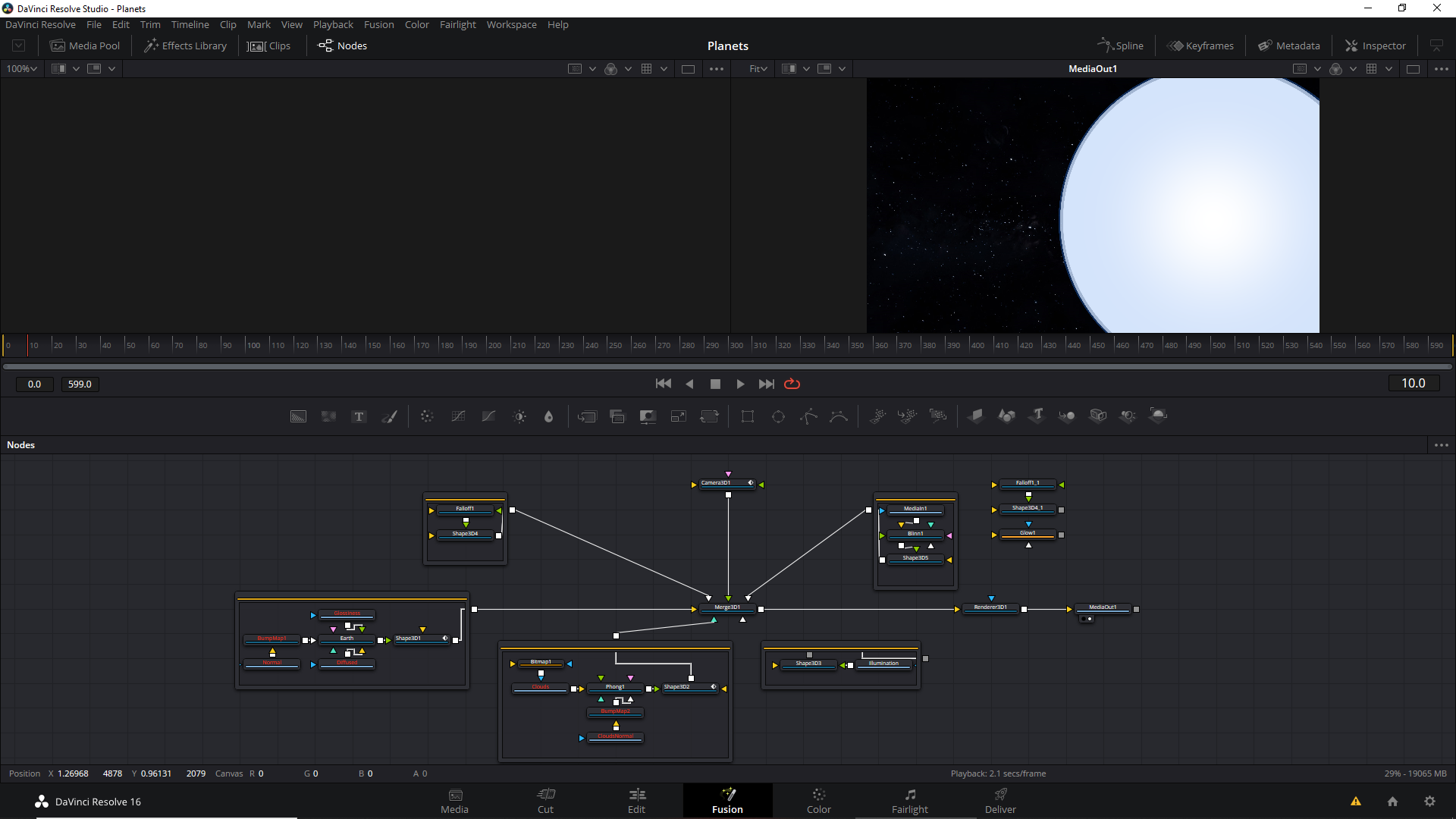
Davinci Resolve fusion tab. Isn't that crazy?
This school year I've also started developing quantitative (financial) algorithms for the stock market, and the math, probability and decision making skills I learned from playing poker a year ago have directly translated into my code! Or as a more fun example, I've started playing badminton recently, and the flexibility and leg power I learned from years of Taekwondo as a child have been super useful when playing. I have dozens more examples, which are all to say that you should just do, because whatever skills you learn will be useful in the future.
Plus, the people who are the best at what they do are the best because they "do". Every top athlete played thousands of games, every genius mathematician did thousands of practice problems, and every great software developer has built dozens of projects.
At the end of the day, no one has gotten anything done by not doing, so you should get your hands dirty and just start working on the thing you love!
Good luck on your university applications :D
Some more great resources for admissions and for learning how to do cool things in general
Applying Sideways - MIT admissions guide, How to do Great Work - Paul Graham, How to get good recommendation letters - Mahadthementor
My contact if you have any questions (or just want to talk!):
Email: vincent.qu@mail.utoronto.ca
Discord: Icyfallblade
Footnotes
-
I was originally in the IB program for Gr. 9 and 10 pre-IB. However, I decided not to continue with the regular IB program in Gr. 11 and 12 to focus on coding and computer science, which is what I was actually interested in. At the time, there was no option to take IB computer science courses and I thought that the extra work would've made it nearly impossible to make as many projects and explore as much as I did. Only now do I know that this wasn't true. People exaggerated the difficulty of the IB like crazy when I was in Gr. 9 and 10. Would I go back in time and change my decision if I could? Probably. But given the information I had at the time, I think I made the best decision possible. ↩
-
I know brilliant, national level math/computer science kids with great grades that got rejected from schools like Waterloo just because they procrastinated their app and wrote it on the last day. Although I can't confirm with 100% certainty that their written application was the reason for their rejection, seeing other kids with far less impressive profiles get accepted into the same programs with no other differences, it makes it pretty clear that their written application was the reason why. In contrast, my university and scholarship application doc was 100+ pages by the time I was done with it. You definitely can't get that done in one night! ↩
-
Yeah I personally have no explanation as to why I got rejected from Waterloo CS. I know a lot of my peers whose application profiles were very strong but weren't as CS oriented who were accepted into both CS and CS/BBA, so maybe UW was just looking for less pure CS students to accept this year. It also just might be a result of variance or maybe I just wasn't strong enough/what they were looking for! Just don't be scared of applying to Waterloo CS because I got rejected lol, you'll probably get in if you deserve it. ↩
-
University applications are random man. Understanding this will help you a lot when receiving rejections or other not-so-desired results. While on average, a stronger applicant will get into more competitive schools, it's not at all a deterministic algorithm—there's tons of variance. Whether it be because an AO is having a terrible day or some hidden systems we don't know about, I've seen some CRAZY application results that just don't make any sense. For example, two of my friends who got into Waterloo CS + national mathematics scholarship (top ~20 strongest math kids entering Waterloo) and CS/BBA both got rejected from Western CS + Ivey. Western CS + Ivey (especially Ivey) is a competitive program, needing around a 95 average or higher, but it is nowhere near as competitive as Waterloo CS or CS/BBA (let alone national math scholarship!), which usually requires a 97-98+ average with strong ECs. As another example, I was accepted to Waterloo SE (arguably more competitive than CS) and won the SL scholarship at 2 of the other top 3 CS programs in Canada, yet I still got rejected from Waterloo CS and CS/BBA and I didn't even get into UofT CS first round (even though I won SL scholarship for UofT CS). I also know a guy who won the SL scholarship for Waterloo SE but got rejected from Waterloo CS. This variance is even worse for US schools. In Canada, a strong enough applicant will get accepted to pretty much every program they apply to, whereas in the US it's pretty much impossible to guarantee acceptance to any single program. Pretty much every kid at MIT got rejected from Harvard or Stanford and vice versa. This is all to say that you shouldn't let a few bad results affect you negatively, because it really is random. ↩